At Delasport, some of the most inspiring career stories begin not with a carefully mapped-out plan, but with curiosity, personal ownership, and the courage to take the first step.
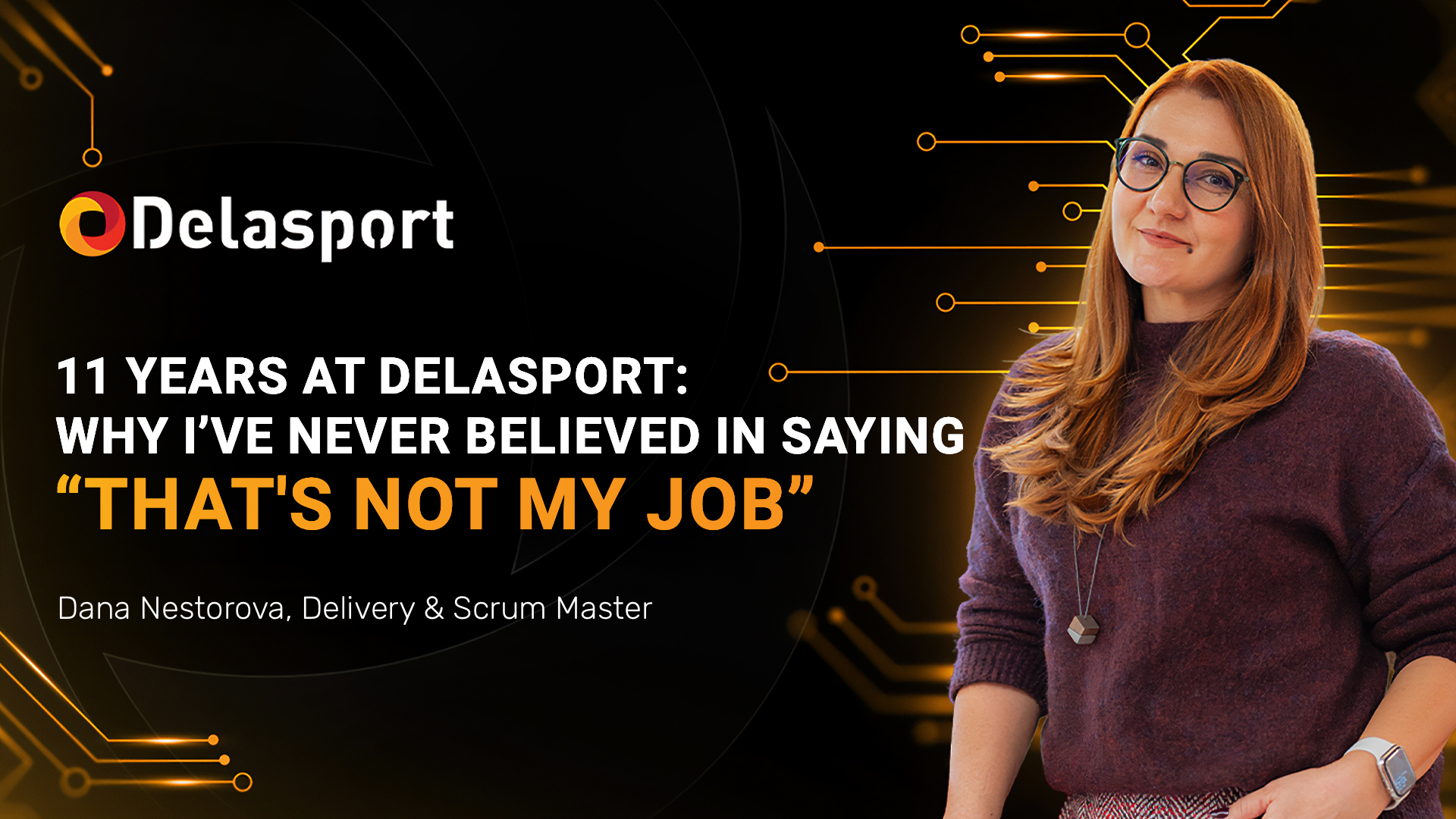
Dana joined the company eleven years ago with no previous experience in Quality Assurance. During her very first week, she faced an unexpected challenge: moving forward on her own without the mentor she had expected to rely on. Today, she is a Delivery & Scrum Manager, leads her own team, and continues to live by the belief that has shaped her career: “That’s not my job” should never be a reason to ignore a problem you can help solve.
In the following story, Dana shares how taking initiative and making consistent, incremental improvements have shaped her professional growth, what it means to be responsible for the development of her team, and why she sees leadership as a responsibility rather than a privilege.
When I joined Delasport 11 years ago, I had no experience in QA. I had recently decided to change careers after completing a Quality Assurance course while on maternity leave with my first daughter. At the time, Delasport was still a relatively small company, and this was going to be my first role in the industry.
I was incredibly excited because I knew I had so much to learn. I was fortunate to be paired with an experienced Senior QA who was supposed to mentor me and teach me the ins and outs of the profession. But my first week did not unfold the way I had imagined. Just a few days after I joined, my colleague handed in their notice.
Suddenly, the plan was gone, and I was on my own.
Looking back, I realize that this was the first defining moment of my career. I remember telling myself, “I’ll figure it out.” I didn’t know how, but I have always believed that the “how” reveals itself once you have decided not to give up.
That mindset has stayed with me ever since.
I have never believed that the quality of your work should depend on whether someone is watching.
To me, the way we work says far more about us than any job title ever could. The standards I set for myself matter more than other people’s expectations. I can simply meet those expectations, or I can go one step further - not because someone requires it or because I am looking for recognition, but because the quality of my work reflects who I am.
When I look back on the past 11 years, I can see that this mindset has shaped every opportunity that followed. I have never chased the next position. What has always mattered more to me is contributing beyond the boundaries of my job description.
I don’t think I have changed dramatically as a person over the years. If anything has changed, it is my confidence. Today, I feel comfortable discussing ideas, asking questions, and proposing solutions, whether I am speaking to someone who joined yesterday or to a member of senior management. Experience has taught me that good ideas are not defined by job titles. They can come from anywhere, if we are willing to listen.
One thing, however, has never changed: my curiosity.
After all these years, what keeps me curious is not the prospect of another title or promotion. My greatest sense of satisfaction comes from solving a problem that genuinely matters. Sometimes that means improving a process everyone has long accepted as “just the way things are.” Sometimes it means bringing the right people together to find a solution. At other times, it means helping a team overcome an obstacle or restoring the confidence of someone who has lost theirs. No two situations are ever the same, and that is exactly what makes the work so interesting.
People often ask me what taking initiative looks like in everyday work.
For me, it is rarely about making a grand gesture. More often, it begins with noticing that something could be better and choosing not to walk past it. Some of the improvements I am most proud of began with a small observation - a recurring issue, an unnecessary step in a process, a lack of clarity, or a conversation no one was having. One small change rarely transforms everything overnight. But many small improvements, made consistently over time, can completely change the way people work together.
Perhaps that is why I have never accepted “That’s not my job” as an excuse.
To me, personal ownership does not mean doing everyone else’s work. It means refusing to ignore a problem that affects everyone. It means asking the difficult question, respectfully challenging the status quo, and offering help even when you are not required to. The greatest opportunities in my career never began with someone giving me permission. They began with curiosity and a willingness to take the first step.
Interestingly, I never set out to become a leader.
It happened naturally.
Today, leading my own team is perhaps the greatest responsibility I have ever taken on. To me, leadership is not about having all the answers. It is about creating an environment in which people can grow, make decisions, and become better at what they do. I try to be someone who shares knowledge, mentors, supports others, and most importantly - leads by example.
And this is also where I am most critical of myself.
When I first started managing people, I constantly questioned whether I was doing a good enough job. No one teaches you how to be responsible for someone else’s development. Finding the balance between doing the work yourself and giving another person the opportunity to learn is not easy. Even today, there are moments when I ask myself whether I am doing enough for the people on my team, whether I am helping them grow, and whether I am preparing them for the challenges ahead.
I believe these are healthy questions to ask. They remind me that leadership is not a privilege - it is a responsibility.
People also often ask me what success means to me today.
Interestingly, my answer has barely changed.
For me, success has never been about a position or a title.
Success means giving the best you are capable of and trusting that the rest will follow naturally. Experience comes with time. Interesting challenges come. Respect and trust are earned along the way.
Perhaps the clearest sign of success, however, is something much simpler.
After 11 years, I still wake up looking forward to the working day ahead.
If I could give one piece of advice to someone just starting their career, it would be simple:
Do not wait for someone to give you permission to make something better.
Stay curious. Ask questions. Listen more than you speak. Do not be afraid to admit when you do not know something, but do not let that stop you from trying. Your job description defines your responsibilities. The way you think and act defines your career.
When I reflect on where this mindset comes from, I find the answer much earlier than the beginning of my career. As a child, I loved mathematics.
It was not because I loved numbers. It was because mathematics taught me something far more valuable: every problem has a starting point, an objective, a set of constraints, and a logical path connecting them. That way of thinking has stayed with me throughout my career. Whether I am addressing an organizational challenge, improving a process, or helping resolve a conflict, my first instinct is to take a step back, assess what I have to work with, understand the desired outcome, and identify the logical steps required to get there.
That is also what I tell my two daughters when they ask, “Why do we even need to learn mathematics?”
Because mathematics does not only teach you how to solve equations.
It teaches you how to think.
And that is a skill that stays with you for life.
What do I hope for in the years ahead?
To keep learning. To meet people who inspire me. To continue finding solutions to complex problems. And above all, to keep loving what I do.
Because after 11 years, I still believe that the best opportunities rarely come with a set of instructions.
They begin with curiosity, personal ownership, and the willingness to take the first step.