In the world of sports betting, Quality assurance plays a critical role by ensuring that betting platforms operate accurately, reliably and securely. These systems operate in real time and high volume transactions. An error can lead to regulatory issues, financial losses and loss of user trust. Product quality is often measured in seconds and split-second decisions. Behind the stability of such systems are the QA teams who help maintain stability, fairness and smooth user experience for betters.
Working in such an environment builds skills and a mindset that extend beyond a specific role. Whether it’s managing markets or ensuring product quality, the ability to quickly assess risk, make precise decisions, and understand the consequences of every action is equally critical. This similarity in mindset is what enables a seamless transition from sports betting to Quality Assurance.
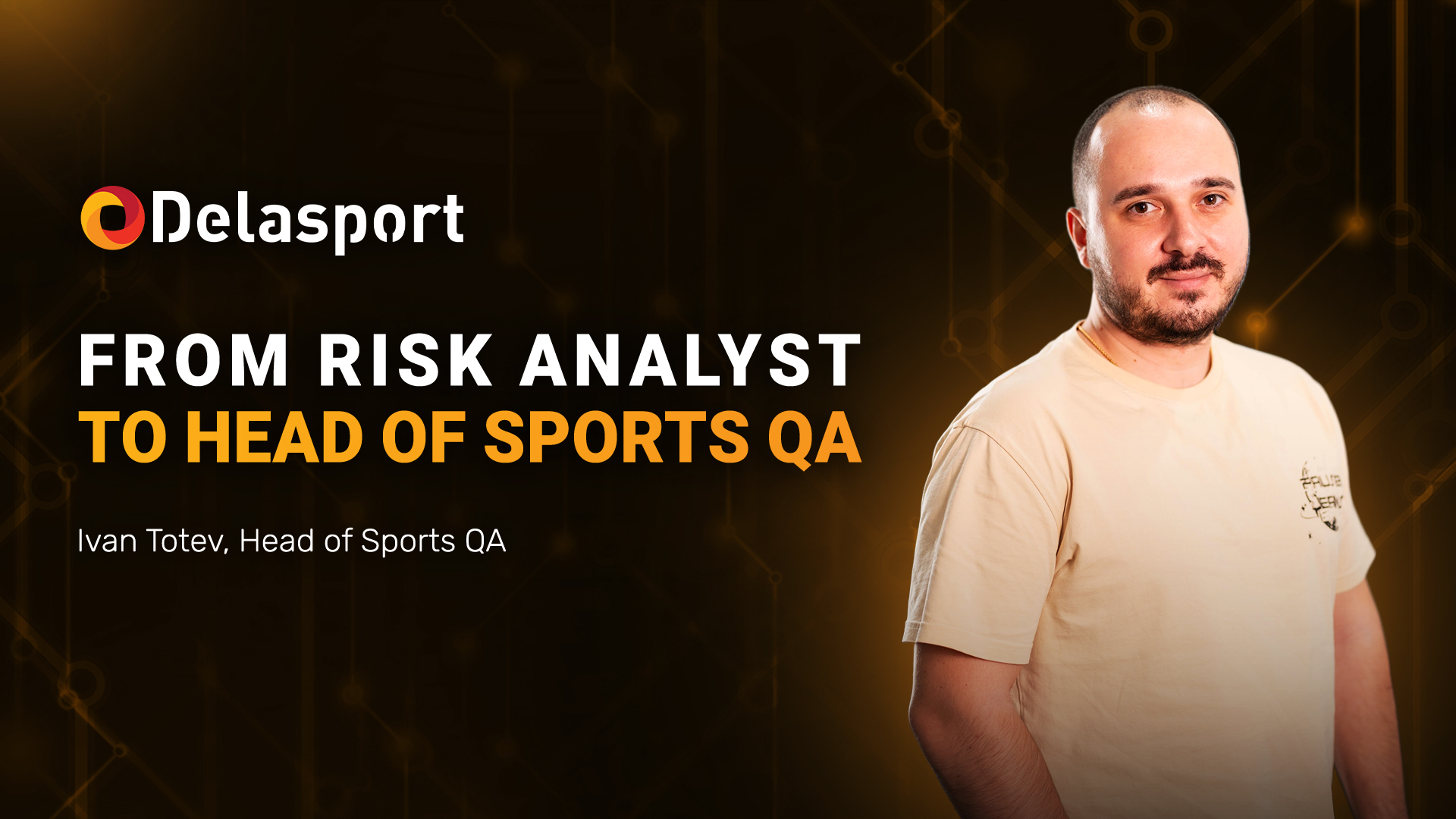
Ivan Totev’s career is a strong example of this path - now Head of Quality Assurance in Delasport’s Technical Department, he has been with the company for nearly four years. His professional journey began in the sports department working in a dynamic environment, analyzing data and collaborating within a team. Today, he applies that experience in building strong testing processes, mentoring QA members and ensuring high standards throughout the development lifecycle. With a focus on collaboration, efficiency and continuous improvement, Ivan and his team help deliver stable, high-quality solutions while supporting the team in meeting both technical and business goals.
I started my career as a Risk Analyst, but my interest in the iGaming industry began much earlier. Prior to that, I worked at a casino, and that’s when I realized that what fascinated me the most wasn’t the betting itself, but how the system works “behind the scenes.”
I was never a typical customer. I was always curious about how the games were designed, how the odds were calculated, how the software tracked every bet, and the ways in which a single mistake can impact both the customer and the business.
As a Risk Analyst, I began to understand the product much more deeply. Over time, I realized that my true passion was not in managing risk, markets, or odds, but in preventing problems before they even reach the customer.
The Quality Assurance role gave me exactly that opportunity by developing a strong eye for detail and a deep understanding of how systems and processes can fail. In that sense, the transition to Quality Assurance felt completely natural.
It’s a bit like moving from being a player on the field to becoming the coach - because that’s where you start to see the whole picture.
Both professions share many similarities. You need to think quickly and logically, anticipate possible scenarios, and be able to assess risks and potential consequences.
My experience as a Risk Analyst helped me understand the product at a level that colleagues from other departments often don’t reach. I understand what customers want because I always asked myself what I would miss if I were in their position. From there, the business logic began to fall into place naturally.
My experience as an analyst provided a strong foundation for testing, particularly through skills like analytical thinking, data analysis, attention to detail, and risk assessment.
As a Risk Analyst, I worked with huge volumes of data in real time - statistics, odds, risk indicators, and much more. The environment is extremely dynamic, with constant changes in events, and my reaction often had to be immediate.
In Quality Assurance, when you test live events, you don’t have the luxury of taking your time to think things through. My analyst experience prepared me well for exactly these kinds of scenarios.
There wasn’t a single “magic moment.” The transition didn’t happen overnight - it was the result of consistent effort, leadership and taking on responsibilities beyond my role, asking a lot of questions, and looking for solutions instead of waiting for instructions. Over time, this helped me build confidence and gain a broader understanding of both the role and the processes.
In the beginning, the biggest challenge was not having a clear understanding of what the Quality Assurance role looks like in a real working environment. One of the challenges I faced was adapting from a primarily analytical position to a more technical, hands on role.
I was entering a new profession and was still building an understanding of expectations, responsibilities, and my place in the decision-making process.
Over time, I also realized that the role often remains on the periphery, which can sometimes lead to certain problems being underestimated or postponed. What helped me adapt faster was my strong understanding of the product and my willingness to actively participate in processes.
The most important thing is to understand the product in depth, not just from a user perspective but also how it is built and maintained. It is crucial to take time to learn the tools, frameworks and methodologies used in QA.
They should ask questions, look for the reasoning behind requirements, and not be afraid to express well-argued opinions. Quality Assurance is a role that requires problem solving, consistent attention to detail and a proactive attitude. It is for people who take responsibility and understand their impact on the final outcome.
For me, an effective team is not built around tools, but around mindset. I focus on three core principles: clarity, collaboration and continuous improvement.
At the core lies a strong understanding of the product and the business - not simply completing tasks. A QA specialist who doesn’t understand why a particular feature is important will struggle to prioritize correctly.
Another key principle is clearly defined responsibility. In our team, there is no room for “this is not my problem.” Quality is a shared responsibility. In that sense, everyone must clearly understand their role and influence.
This creates confidence and independence within the team and eliminates the need for micromanagement.
Live betting is, by definition, a high-intensity environment because everything happens in real time.
For me, preparation, task prioritization, and quick risk assessment are fundamental. My experience as an analyst has always helped me recognize critical situations early on and avoid wasting valuable time. I focus on assessing risks methodologically, making decisions based on data rather than impulse and preparing for multiple outcomes.
From a leadership perspective, I try to prevent that pressure from spreading to the team. My role is to remove the ‘noise’, define priorities, and maintain control of the situation. This allows my team to stay focused and effective without panic.
New technologies should not create dependency or resistance to change within the Quality Assurance department. Instead, they should shift focus toward higher-value work.
The real question isn’t about adopting new technologies, tools, or automation- it is about solving real problems. Without alignment with the product, even AI and automation add little value.
My responsibility is to identify where automation delivers the greatest value and to adopt AI and new technologies in ways that enhance product quality and team efficiency. My focus is on stability and early issue detection, rather than simply increasing the number of automated tests.
In my opinion, Quality Assurance will become much more integrated with both product and business. It will become increasingly strategic and technologically advanced.
Traditionally, QA has often been seen as the final checkpoint before releasing a feature. In the future, QA specialists will be involved much earlier - even during the stage when requirements are being defined.
This will undoubtedly bring greater value to the business.
AI will certainly change the nature of our daily work by performing automate complex testing, predict system failures or errors, enable data driven decisions and support regulatory compliance. However, human judgment will remain just as important, especially in complex scenarios.